Tuesday, October 8, 2019

Museum Piece No. 13 by Rufus King (1945)


Also published as Secret Beyond the Door

About the author: See this Wikipedia article.

Major characters:

The Blaze Creek household:
  • Lily Rumney, formerly Lily Constable, 2nd wife of Earl Rumney
  • Earl Rumney, wealthy newspaper owner
  • (the late Eleanor Rumney - Earl's first wife)
  • (the late Wilbur Constable, Lily's first husband)
  • Aderic Rumney, teenage son of Earl and Eleanor
  • Diana Goff, Earl's sister
  • Silas Goff, Diana's husband
  • Dillon Sobolenski, a dour composer and house guest
  • Zelma McQuillan, Earl's personal secretary, who conceals her face
  • Mrs. Lovelake, creepy housekeeper
  • Mildred, Lily's maid
  • Griswold, chauffeur
Others:
  • Hubert Coache, bank VP, Lily's old friend and confidante
  • Leona Drumm, news columnist
  • Dr. Lawrence Russack, a psychiatrist
  • Dr. Harley Linder, a physician
Locale: Lebanon Falls, New York; near New York City

Synopsis: 

Our protagonist Lily Constable is newly married to Earl Rumney and moving to her new mansion home, Blaze Creek. It is a second marriage for both - Lily's first husband, Wilbur Constable and Earl's first wife, Eleanor Rumney, are both dead. Earl has a teenage son, Aderic, by his first wife. 

Blaze Creek is a big mansion with a big staff, 12 women and six men. It is run by housekeeper Mrs. Lovelake, with business affairs handled by secretary Zelma McQuillan; who partially conceals her face with scarves.

Already there is belief that Earl has only married Lily for her money. His newspaper needs a lot of capital, and Lily is quite wealthy. Lily is barely moved in when Earl has her sign a power of attorney (red flag!).

Earl has told her he has a hobby of decorating certain rooms in the mansion. In fact, there are 13. It turns out that each room contains a tableau of a murder (with no bodies, just the rooms staged as they appeared). 12 of the rooms are "public" and he happily shows them to guests. But room 13 is his secret room, and no one, including Lily, is allowed to see inside. Lily is concerned about his mental health, as her psychiatrist friend Dr. Lawrence Russack has warned her to beware if Earl keeps any of the rooms a secret. Russack urges her to get a copy of the key and look inside.

Review: "Last night I dreamt I went to Manderley again." If you can identify that opening line, you will enjoy this book. This story is a parallel to Daphne DuMaurier's 1939 novel Rebecca. The second wife coming to be mistress of a creepy mansion with a cold husband, the ever-present memory of the former mistress, and a creepy housekeeper is right out of that novel; although our protagonist Lily Rumney is quite a bit more assertive than the wife in Rebecca (who even lacks a name).

Then it gets interesting, with the addition of the secret rooms (taken from the French folktale Bluebeard). 

There are 13 rooms, but we only get a peek into a couple. The content of the secret room is easy to predict, but still an enjoyable read as Lily seeks to solve the mystery in some daring escapades.

My only criticism is that the author has made quite a word salad in this book, full of long complex words which may send you to the dictionary repeatedly. There were some paragraphs which just defy understanding completely.


Friday, October 4, 2019

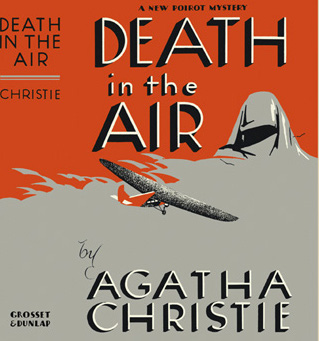
Death in the Air by Agatha Christie (1935)

dustjackets.com


Major characters:

Seat 2. Marie Morisot, a.k.a. Madame Giselle, moneylender to the society set
Seat 4. Mr. James Ryder, director of a cement company
Seat 5. M. Armand Dupont
Seat 6. M. Jean Dupont
Seat 8. Mr. Daniel Clancy, mystery writer
Seat 9. M. Hercule Poirot
Seat 10. Dr. Bryant
Seat 12. Norman Gale, a dentist
Seat 13. Countess Cecily Horbury, cocaine addict
Seat 14. Miss Jane Grey, hairdresser
Seat 17. The Hon. Venetia Kerr
Henry Mitchell, steward
Albert Davis, steward
Anne Morisot, daughter of Madame Giselle
Hercule Poirot
M. Fournier, of the Sûreté

Locale: aboard the airplane Prometheus, en route from France to England

Synopsis:
Hairdresser Jane Grey has won a small amount in a lottery and splurges on a vacation to Le Penit, where she meets dentist Norman Gale and strikes up a friendship. They both wind up on the same flight back to London.

Aboard the rear section of the airplane Prometheus, there are 11 passengers, 2 stewards, and one annoying wasp making the flight from Le Bourget in Paris to Croydon in England. The wasp buzzes around until it is killed by M. Jean Dupont. Madame Giselle seems to be sleeping in her seat, but upon inspection, is really dead. Hercule Poirot finds a poison dart on the floor, matching a puncture in Madame Giselle's neck. Upon landing, a search of the plane finds the matching blowpipe, stuffed down beside M. Poirot's seat. Poirot and his counterpart M. Fournier, of the Sûreté seek to find who the killer is.

Review: If nothing else, this demonstrates how air travel has deteriorated. Windows that open! Ordering a meal from the menu - on a flight of less than one hour! But as to the review, a mystery that has Poirot - and the reader - befuddled until the very end. Clues are set out for the reader, but their significance? A dead wasp and a spoon are vital to the solution. The mystery takes a turn and seeks answers in the past, and in faraway Québec; in order to be solved. Of course, the unexpected ending will tickle your little grey cells!

Also see Review #1 and Review #2 by Bev Hankins on My Reader's Block.

Sunday, September 29, 2019

The A.B.C. Murders by Agatha Christie (1936)

dustjackets.com


Major characters:

The unfortunate victims:
  • A. Ascher, a convenience store owner
  • Elizabeth "Betty" Barnard, a waitress
  • Sir Carmichael Clarke
  • George Earlsfield, a theatre patron
The Special Legion:
  • Mary Drower, niece of A. Ascher
  • Megan Barnard, sister to Betty Barnard
  • Donald Fraser, fiancé of Betty Barnard
  • Franklin Clarke, brother of Sir Carmichael
  • Thora Grey, secretary to Sir Carmichael
The prime suspect:
  • Alexander Bonaparte Cust, a door to door salesman
Hercule Poirot
Captain Arthur Hastings, our narrator

Locale: various locations in England

Synopsis: The book is written in two parallel accounts: by our narrator, Captain Hastings; and another account by salesman Alexander Bonaparte Cust.

Hercule Poirot receives a letter from "A.B.C." notifying him of an intended murder in Andover. Ms. A. Ascher is struck down and killed. A second latter notifies him on an intended murder in Bexhill. Betty Barnard is found strangled. A third letter notifies him of an intended murder in Churston, and Sir Carmichael Clarke is struck and killed.

Authorities scramble to stop the killer, but are unable to get ahead of him as he speeds through the alphabet. The account by Cust describes his visit to each of these communities.

A fourth letter predicts a murder in Dorcaster. A man is killed in a theatre, but his name does not contain a D. However, the patron next to him does have a 'D' name, so it is assumed the wrong person was attacked in the dark.

Poirot's strategy to find the killer is to learn as much as he can about him. He forms a Special Legion consisting of persons connected to the victims, and has them search their minds for clues - and then they find a commonality to the murders.

Review:

The format of two parallel accounts is intriguing, and we are led to believe we know who the killer is right away. Don't be too confident. The series of murders in alphabetical order is reminiscent of some of the Ellery Queen mysteries in which serial murders occur. The use of the Special Legion is interesting, and shows that deep questioning and reflection may sometimes reveal the needed clue.

See also this review by Bev Hankins on her blog, My Reader's Block.


Sunday, September 22, 2019

Fair Warning by Mignon Eberhart (1935)

dustjackets.com


Major characters:

The Godden household:
  • Marcia Godden, our protagonist, wife of...
  • Ivan Godden, just home from the hospital
  • Beatrice Godden, Ivan's sister
  • Emma Beck, cook
  • Ancill, chauffeur
  • Delia, housemaid
The Copley household, next door:
  • Robert Copley, Marcia's secret love
  • Verity Copley, Robert's widowed mother
  • Stella, housemaid
And:
  • Galway "Gally" Trench, Marcia's cousin
  • Dr. Graham Blakie
  • Jacob Wait, detective
  • Lt. Davies


Locale: Baryton, a tony suburb of Chicago

Synopsis:

Marcia Godden is dreading the return home of her husband, domineering Ivan Godden, after a hospital stay of a month following a car accident. He is now in good health but has a bandaged foot. Ivan is bad to her. She longs for her love, Robert Copley, next door; but has refrained from any sort of affair in loyalty to her marriage.

The Copleys host a dinner party on the evening Ivan arrives home. Marcia dresses and comes downstairs, one of the last to leave. She looks in the library and finds Ivan on the floor, a knife in him. He urges her to pull it out - as she attempts to, he dies. His sister Beatrice Godden walks in to see Marcia kneeling over him, both hands on the knife.

Marcia knows she didn't do it, and believes Robert has done this to get Ivan out of the way. They share that motive, and Robert had penned a love letter to Marcia which is stashed in the library as the police search the premises. Another murder will follow as suspicion points to Marcia.

Review:

The signature Eberhart love triangle is set up immediately. Protagonist Marcia is trapped in a bad marriage to a bad man, with much-better-choice Robert Copley lined up right next door. This is classic Eberhart at her best. The descriptions of the household, and particularly the library, are perfect. The case builds against a certain person - but then, that person is murdered also. This has a small cast of characters, and even a loose end at the end (what happened to Ancill?) does not detract from it.


Friday, September 20, 2019

Bats Fly At Dusk by A. A. Fair (1942)

dustjackets.com


Major characters:

  • Rodney Kosling - a blind street vendor
  • Josephine Dell - secretary to Marlow Milburs, accident victim
  • Harlow Milburs - deceased, historical author
  • Christopher Milburs - his nephew, a Vermont farmer
  • Nettie Cranning - Harlow's housekeeper
  • Eva Hanberry - Nettie's daughter
  • Paul Hanberry - Eva's husband
  • Myrna Jackson - Josephine's roommate
  • Jerry Bollman - a witness and wheeler-dealer
  • Bertha Cool - detective
  • Donald Lam - detective

Locale: Los Angeles, CA

Synopsis: Blind street vendor Rodney Kosling has struck up an acquaintance with an anonymous woman, who passes by him each day. Then she is struck by a car - but not seriously injured - and seems to disappear. Kosling hires Bertha Cool to locate her. Bertha finds the woman is secretary Josephine Dell, and is no longer passing down the street as her employer, Harlow Milburs, has died; ending her job in that area.

A witness to the accidenty, Jerry Bollman, makes overtures to Bertha that he has information which can reap a big insurance settlement from the accident.

Christopher Milburs, a Vermont farmer and only relative of the late Harlow, comes to town to handle his estate. Things are fishy, a suspect will is found and it could be a forgery perpetrated by housekeeper Nettie Cranning and her relatives.

Bertha goes to see Rodney Kosling and enters his home - which has no lights, he doesn't need them. She finds his pet bat flying around and the body of Jerry Bollman on the floor.

Bertha's partner, Donald Lam, is in the Navy but contributes to the investigation by frequent telegrams.

Review: This is one of the early Cool/Lam books and is a nice tight, cohesive read. There is a small cast of characters, and few of the red herrings, complications, and random walk-on walk-off cameos common in the later books. Bertha works hand in hand with the police, not as an adversary. The book has several unique aspects: the well developed character of the blind man and his explanations of how he manages his life, the interplay with the bat, and the appearance of Donald Lam only by telegram.


Thursday, September 5, 2019

Three Days for Emeralds by Mignon Eberhart (1988)

(I know, 1988 is not Golden Age, but her career was mostly in the Golden Age).


Major characters:
  • Alicia "Lacy" Wales, our protagonist, legal secretary to Hiram Bascom
  • Hiram Bascom, attorney
  • Richard Blake, Lacy's fianceé, secret government agent
  • Rose Mendez, neé Murphy - appealed for help but didn't get it
  • Carlos Mendez - Rose's ex
  • Yolanda Mendez, Carlos' current wife
  • Inez Wales - Lacy's stepmother
  • Rafael - Inez' brother
  • Burden "Buddha" Smith, neighbor and confidante
  • Spook, Buddha's manservant
  • Hobie Fellows - a teen gas station attendant
  • Captain O'Leary - police
Locale: New York City and environs

Synopsis: Alicia "Lacy" Wales, legal secretary, receives a letter from old friend Rose Mendez, appealing for help. Lacy asks her boss, Hiram Bascom, for assistance, and he responds in a confusing manner, even kissing her. Lacy goes to see Rose, to find she has deteriorated into a fat, dirty, candy-eating slug. Lacy hands her a drink of whiskey, she downs it, and immediately falls dead. Lacy goes to look for a sheet to cover her up, and in her bedroom she finds that Rose has a framed photo of Richard Blake - her own fianceé - on her nightstand. 

The Mendez family appears. There is a convoluted divorce/alimony decree between Carlos and Rose, specifying that her alimony will cease if she remarries. Then a marriage certificate is found between Rose and Richard Blake. Lacy is torn to find her fianceé may have married Rose behind her back.

Review: This is Eberhart's last novel. In 1988 she was 88 or 89, and it is sad that her writing is just not cohesive and magic any more. I considered not finishing it, but stuck with it as a sort of tribute to her career. The action is jerky and illogical, and uses way too many exclamation points, Nancy Drew style. It has the flavor of being dictated. After a rough beginning, it does smooth out somewhat to the end.

The action upon discovering Rose's death is especially hard to follow. Eberhart struggles to get someone to notify the authorities. There is an appearance by several "Spaniards" from the fictional country of Logonda who are stereotyped and wo dimensional at best; their background and relationships are tangled and difficult to understand. Their main activity is standing around, drinking, and looking elegant. One, Rafael, carries his pet with him, which is described at various points as a small dog, a cat, or a ferret; which he claims to have found on an airplane (!). Rafael does turn out to be the most believable of the lot.

Various scenes are just not credible - for example, a family interview by the police breaks into a knock-down drag-out fight and the police just idly wait for it to be over. Lacy drinks a drugged martini, recovers and vows to not drink anything another has prepared - and on the same page accepts and drinks a cup of coffee from Inez - the vow didn't last long. Golden Age clichés remain in vogue - poisoned chocolates and spiked drinks abound.


Wednesday, September 4, 2019

Five Passengers from Lisbon by Mignon Eberhart (1946)

dustjackets.com

About the author: (from Goodreads): Mignon Good (1899-1996) was born in Lincoln, Nebraska. In 1929 her first crime novel was published featuring 'Sarah Keate', a nurse and 'Lance O'Leary', a police detective. This couple appeared in another four novels. Over the next forty years she wrote a novel nearly every year. In 1971 she won the Grand Master award from the Mystery Writers of America. 

Major characters:

The five passengers on the lifeboat:
  • Marcia Colfax, our protagonist
  • Mickey Banet, a.k.a. André Messac, a concert pianist; her fiancé
  • Luther Cates
  • Daisy Belle Cates, his wife
  • Gili Duvrey
Crew of the Lerida on the lifeboat:
  • Alfred Castiogne, doomed
  • Manuel Para
  • José Urdiola
Crew on the hospital ship S. S. Magnolia:
  • Captain Lars Svendsen
  • Colonel Josh Morgan, a patient
  • Colonel Wells, a doctor

Locale: on the Atlantic Ocean

Synopsis: WWII has just ended in Europe. Five people in Lisbon, Portugal are anxious to get out of Europe the fastest way possible, and book passage on the freighter Lerida, bound for Buenos Aires - rather than have a long wait for passage direct to the US. They are Marcia Colfax and her fiancé Mickey Banet (who is travelling under the name/passport of Frenchman André Messac for an undisclosed reason), wealthy Luther and Daisy Belle Cates, and beauty Gili Duvrey. The Lerida runs into trouble in a storm, and goes down. The five passengers and three of the crew take to a lifeboat.

Mickey was a concert pianist before the war, but the Nazis injured his fingers while he was in a concentration camp.* Marcia and Mickey try to keep his true identity (Mickey Banet) a secret from Captain Svendsen just to keep things simple.

One of the crewmen, Alfred Castiogne, collapses just as the lifeboat is intercepted by the hospital ship Magnolia. When they get him aboard, he is already dead - stabbed in the back. The murderer had to have been one of them in the lifeboat, and now they are all on the hospital ship. Captain Svendsen tries to find the murderer, but the murderer is not done yet. 

Review:

Atmosphere. A ship creeping across the Atlantic in a thick fog with a murderer aboard. There is a small pool of suspects - just the five passengers rescued from a lifeboat  - and one of them must be the murderer. I had the opportunity to read this while sitting on a Maine beach with ships visible on the horizon, a perfect setting for a mystery read. Of course, it was daytime, no fog, and I was quite safe on land.

The book features the usual Eberhart love triangle - the innocent protagonist (Marcia Colfax), the fiancé who is all wrong for her (Mickey Banet), and a newcomer who is perfect for her (Josh Morgan). 

John Morgan is the character who is a bit puzzling - he is a patient yet he has the run of the ship and the ear of the officers. I expected him to turn out to be something else, but he remained a patient.

The mystery patient walking around, unable to speak, head swathed in bandages with only his eyes showing, seemed a bit typecast at first but did develop into a believable person.

A great read - but not one to take on a cruise.

* For other mysteries which involve a concert pianist who has suffered a hand injury and is unable to play again, see Deep Lay The Dead by Frederick C. Davis (1942) and The Man Who Didn't Mind Hanging by Nancy Barr Mavity (1932).

Also see this review by Bev Hankins on My Reader's Block.