Showing posts with label Christie; Agatha. Show all posts

Wednesday, August 20, 2025

The Mystery of the Blue Train by Agatha Christie, 1928


dustjackets.com


Series: Hercule Poirot #6

Locale: England and France

Major characters:
  • Rufus Van Aldin, American millionaire
  • Major Richard Knighton, his secretary
  • Ruth Kettering, his daughter
  • Derek Kettering, Ruth's husband
  • Ada Mason, Ruth's maid
  • Armand, Comte de la Roche, a pretender
  • Mme. Mirelle, a Parisian dancer
  • Mary Ann (Mrs. Samuel) Harfield, Emma's cousin
  • Katherine Grey, Emma's companion, with the grey eyes
  • Lady Tamplin, Katherine's cousin
  • Lenox Tamplin, Lady T''s daughter
Synopsis:

American millionaire Rufus Van Aldin has presented his daughter, Ruth Kettering, with a selection of priceless rubies as a gift. He is also trying to persuade her to divorce her husband, Derek Kettering, who is having an affair with Parisian dancer Mirelle. Ruth agrees. Ruth is no stranger to infidelity herself, having occasional trysts in Paris with greasy gigilo Armand, who has taken the illegitimate title of Comte de la Roche.

Wealthy matriarch Emma Harfield has passed away (prior to the story), leaving her entire estate to her long time companion, Katherine Grey. Katherine enjoys her new wealth with a spending spree on new clothes and travel to the Riviera. Two grasping relatives proceed to suck up to Katherine with an eye on getting part of her booty: Mary Anne (Mrs. Samuel) Harfield, Emma's cousin; and Lady Tamplin, Katherine's cousin.

Ruth takes The Blue Train to the Riviera, and meets Katherine on board. Unknown to Ruth, her husband Derek is also on board. The next morning, Ruth is found murdered in her compartment; and the rubies missing. Derek stands to inherit her entire fortune, but if he is the murderer, why take the rubies? The police suspect the Comte de la Roche, who was also on board. Yet another passenger is Hercule Poirot who is asked by Van Aldin to find the murderer.
 

Sunday, April 13, 2025

The Seven Dials Mystery by Agatha Christie, 1929


dustjackets.com

Series: Superintendent Battle #2 (of 5)
 
Major characters:
  • Jimmy Thesiger
  • Gerald Wade, the late sleeper, victim #1
  • Loraine Wade, his half-sister
  • Bill Eversleigh
  • Ronny Devereux, victim #2
  • Lord Caterham, owner of Chimneys
  • Lady Eileen Brent, "Bundle", Lord Caterham's daughter
  • Tredwell, butler
  • MacDonald, gardener
  • Sir Oswald and Lady Marie Coote, renters of Chimneys
  • Rupert Bateman, Sir Oswald's secretary
  • George Lomax, "Codders", a cabinet minister

Locale: near London

Synopsis: Gerry Wade was known for sleeping late. At a country house party hosted by Sir Oswald and Lady Maria Coote, Wade's friends decide to play a trick on him and stash eight alarm clocks around his bedroom. He fails to rise in the morning, and is found dead. Seven of the clocks have been lined up on the mantle, and the eighth is found outside on the lawn.

Jimmy Thesinger (Gerry's friend ), Loraine Wade (Gerry's half-sister) , and Lady Eileen Brent, a.k.a. "Bundle" (daughter of the country house owners) team up to try and find the murderer. Bundle is driving to London and thinks she has hit a man (Ronny Devereux) but investigation shows he was shot. 

Several mentions of 'Seven Dials' lead the investigation to the Seven Dials Club in the district of the same name. Bundle locates a secret meeting room in the club, and infiltrates the secret Seven Dials Society; in which the seven members disguise their identity by wearing clock face masks, each set to a different number.

Review: A thoroughly enjoyable and fast-moving tale, with Bundle as the take-charge star investigator. There are lots of humorous episodes, including elderly George Lomax's repeated marriage proposals to Bundle; and the time she feigned unconsciousness and just relished listening to everyone being concerned as they hovered over her. It was fun trying to match up the members of the Society (known only as numbers 1-7) with their real identities, and of course, the big reveal of the true nature of the Society. Agatha had a bit of fun leading the reader off in several directions - such as does Seven Dials refer to the seven clocks on the mantle, the London district, the club in the district, or the seven dial masks on the Society members? Sevens and dials abound throughout.

You may also enjoy this review by Bev Hankins on My Reader's Block.
 

Friday, March 7, 2025

Peril at End House by Agatha Christie, 1932


dustjackets.com

Series: Hercule Poirot #8

Major characters:
  • "Nick" Buckley
  • Maggie Buckley, her cousin
  • Cmdr. George Challenger, her boyfriend
  • Charles Vyse, her cousin, a lawyer
  • Frederica "Freddie" Rice, her friend
  • Jim Lazarus, Frederica's consort
  • Bert & Mildred "Milly" Croft, Australian tenants
  • Ellen Wilson, housekeeper
Synopsis: Hercule Poirot and Captain Hastings are on vacation when they meet Miss "Nick" Buckley. She reveals to them she has had three escapes from death in the past days. First, a heavy picture falls from over her bed. Second, a boulder rolls down the path to the beach towards her. Third, the brakes on her car were tampered with. No sooner does she describe these, when a bullet from the bushes pierces her hat.

Nick has a happy-go-lucky attitude about the whole thing. She introduces her companions: boyfriend Commander George Challenger, her best friend Frederica "Freddie" Rice, and Frederica's consort, Jim Lazarus. Freddie is married, but separated - her husband is in parts unknown.

Nick shows Poirot the scenes of each attempt, at her somewhat dilapidated house, End House; which is adjacent to Poirot's hotel. She rents the gatehouse cottage to an Australian couple, Bert Croft and his disabled wife Milly Croft. Questioned as to who may benefit from her death, it is only her cousin, lawyer Charles Vyse; to whom she has left End House in her will. 

Poirot urges Nick to never be alone, she recruits her cousin Maggie Buckley to come stay with her. One night, while everyone is watching fireworks across the bay, Maggie is wearing Nick's distinctive red shawl, and she is shot. Was she - or Nick - the intended victim?

Review: The aspects I liked are: 1). the small cast of characters, making it easy to keep track of the players, without a lot of cardboard two-dimensional red herrings coming in and out. 
2). Poirot's theatrical exposé at the end.

The aspect I didn't care for was the emergence of a significant character at the end of the story, so the reader doesn't get a chance to figure that person in along the way. The other "trick" Agatha pulled on the reader was a bit of surprise, surprise! regarding the names of the characters. (I had enough trouble following girls named Nick and Freddie!)

You may also enjoy:


Monday, February 24, 2025

The Regatta Mystery and Other Stories by Agatha Christie, 1932-1939


This is a collection of short stories featuring Christie's series characters (except #8).

1. The Regatta Mystery: At a luncheon following a yachting party, C. Parker Pyne investigates the case of a valuable diamond. It went missing in a "sealed" room after a teenage girl giggles that she could make it disappear.

2. The Mystery of the Baghdad Chest: Marguerita Clayton's husband is dead, and stuffed in a trunk. Before the body is cold, she wants Hercule Poirot on the case; not to find the killer, but to exonerate her lover.

3. How Does Your Garden Grow? Amelia Barrowby writes to Hercule Poirot for advice. Before he can respond, she is dead by poison. He visits the family to find not only were they  awaiting her inheritance, but placed a curious arrangement in her flower garden.

4. Problem at Pollensa Bay: On vacation in Spain, C. Parker Pyne meets Adela Chester, who certainly does not approve of her son Basil's fiancée, Betty. Pyne manages to adjust Adela's attitude with the help of a mysterious Miss Ramona.

5. Yellow Iris: Hercule Poirot is lured to a dinner party at the Jardin des Cygnes (Garden of the Swans), where there are five present at a table for six, marked by a vase of yellow irises. The host, Barton Russell, explains the dinner is in honor of his dead wife, Iris, who died of poison at a similar party in New York four years earlier; and he knows the murderer is one of them. As Poirot watches, one of the party falls face down on the table.

6. Miss Marple Tells a Story: Mr. Rhodes is suspected of killing his wife in a connecting hotel room. Her room was found locked on the inside, with access only through his own room. Miss Marple figures out who - and how - it was done. The layout is critical, here is my sketch map which will allow you to follow along:


7. The Dream: Benedict Farley asks for Hercule Poirot's advice. He has a recurring dream of looking at his office clock (3:28 PM) and then shooting himself. A week after Poirot interviewed him,  he is found shot dead at 3:28 in his locked room. Despite appearances of suicide, Poirot smells murder.

8. In a Glass Darkly: Our unnamed narrator sees a vision in his mirror, of a woman he admires being strangled by her fiancé. He finally gets the nerve to warn her about it, but then it happens for real. Can this marriage be saved?

9. Problem at Sea: Henpecked Colonel Clapperton and his annoying wife are on a voyage. She retires to her cabin to rest, locking her door. Later she is found murdered in her bed. Hercule Poirot stages a theatrical trick to expose the murderer.

Mini-reviews: 

The Regatta Mystery: We find how the diamond disappears, but the whole episode of the broken wine glass escapes relevance to me. 

Miss Marple Tells a Story: Best of the batch. I spent an enjoyable time  sketching out the layout (above) and using it to follow the paths of two characters - the chambermaid and the killer. It is a clever setup and quite satisfying when you understand how it was done.

Problem at Pollensa Bay: No murder here, just a social engineering episode. Good reading if you don't like who your son/daughter chooses for a mate and you want to "fix" it.

Yellow Iris: Both this story and Miss Marple Tells a Story use the theme of "invisible" people. The two stories are similar, but with a different cast and locale.

The Dream: How to commit a murder which only requires a tremendous amount of advance planning. Interesting way to lure your victim to the window. But why shoot him? Just let him fall out...

In a Glass Darkly: No murder here, but a long-term infatuation turns out OK in the end, all happily ever after. Satisfying, although unfortunate husband #1 got killed in the war. Did you catch the biblical reference? (title from 1 Corinthians 13:12)

Recommendations:

  • Locked-room fans will enjoy 1,6,7,9.
  • Murder mystery fans will enjoy 2,3,5,6,7
  • Cozy fans will enjoy 4.

You may also enjoy this review by Bev Hankins on My Reader's Block.


Saturday, January 25, 2025

Murder in Retrospect by Agatha Christie, 1942


dustjackets.com

 This is Hercule Poirot #25. It was also published under the title Five Little Pigs.

Major characters:
  • Carla Lemarchant, Poirot's client
  • Amyas Crale, a painter, her father (deceased prior to story)
  • Caroline Crale, her mother (deceased prior to story)
  • Angela Warren, Caroline's half-sister
  • Cecilia Williams, Angela's childhood governess
  • Philip Blake, stockbroker, was Amyas' best friend and neighbor
  • Meredith Blake, herb and potion hobbyist, Philips's brother
  • Elsa Greer, Amyas' 'other woman'. Now Lady Dittisham
  • Hercule Poirot
Synopsis: Carla Lemarchant visits Hercule Poirot to ask him to investigate a sixteen-year old murder. Her father, painter Amyas Crale, had been poisoned. Her mother, Caroline Crale, was convicted on circumstantial evidence. The alleged motive was jealousy: Amyas was going to divorce her to marry young Elsa Greer (after several marriages, now Lady Dittisham). Caroline died in prison.

Carla is convinced her mother was innocent. She wishes her name cleared posthumously so that she (Carla) can marry without her fiancé forever thinking her mother was guilty.

Poirot reviews the cold case by interviewing the principals. He finds the poison, a hemlock concoction, had been lifted from the hobby lab of Meredith Blake, brother of stockbroker Philip Blake, who had been Amyas' best friend; and introducted into his beer glass.

Review: One thing I especially liked about this one is that the circle of suspects remains small - always just five. It made it easy to keep track of the cast of characters. Another thing which is unique is that Poirot got each of the five to write a narrative of the 16-year old murder, from their perspectives. These narratives are provided to the reader. 

Finally, Poirot gets a significant clue from one of the five which untangles the entire murder. As he explains it in the denouément, the sequence of events and motives is crystal clear. I kept page-turning to the very end. 

A final note: The (over)use of pronouns instead of proper names in the beginning led me to a misunderstanding: I thought Angela was Carla's half-sister. She is not. She is Caroline's half-sister, about ten years older than Carla. At the time of the murder, Angela was about fifteen, Carla about five. It was puzzling to me why a 15-year-old rated a governess, while the five year old did not! I suppose the governess was in place of a parent for Angela, who did not have any parents in the picture.

You may also enjoy this review by Bev Hankins on My Reader's Block.
 

Saturday, January 11, 2025

The Patriotic Murders by Agatha Christie, 1940


dustjackets.com

Also published as One, Two, Buckle My Shoe and An Overdose of Death

Series: Hercule Poirot #23

Major characters:
  • Henry Morley, dentist
  • Gladys Nevill, his secretary/hygienist
  • Frank Carter, Gladys' fiamcé
  • Mr. --- Amberiotis, a patient
  • Mabelle Sainsbury Seale, a patient
  • Alistair Blunt, a patient and finance administrator
  • Sylvia Chapman
  • Julia Olivera, Blunt's niece
  • Jane Olivera, Julia's daughter
  • Helen Montressor, Blunt's cousin
  • Hercule Poirot
  • Inspector Japp
Locale: London and environs

Synopsis: A routine dentist visit by Hercule Poirot goes horribly wrong. Soon after Poirot leaves, the dentist, Henry Morley, is found shot to death. Inspector Japp looks at the day's patient list, and finds one of the day's earlier patients, --- Amberiotis, was apparently the last person to see Morley alive. Then Amberiotis himself is found dead, followed by another patient, Sainsbury Seale. Japp's suicide theory goes out the window.

Review: This is another Christie with a nursery-rhyme theme throughout. This one was a definite page-turner. I enjoyed the dentist office setting (there are worse possibilities than a drill). There is a switcheroo drama between Sainsbury Seale and Sylvia Chapman which has a surprising result. The mystery gets deeper and deeper with some international intrigue stirred in and some people who are not what they seem. Poirot's step-by-step denouément at the end revealed a surprising twist of how the murders were done. I can appreciate why the early title of The Patriotic Murders was changed - focusing on the most patriotic person in the story can be a definite spoiler.

Note:
 There is one occurence of the n-word.

You may also enjoy this review by Bev Hankins on My Reader's Block.


Saturday, November 23, 2024

Third GIrl by Agatha Christie, 1966


Series: Hercule Poirot #40

Major characters: 
  • Norma Restarick, the third girl
  • Frances Cary, artist, the second girl
  • Claudia Reece-Holland, secretary, the first girl
  • Andrew Restarick, Norma's father
  • Simon Restarick, Andrew's brother [deceased]
  • Mary Restarick, Norma's stepmother
  • Sir Roderick Horsefield, Mary's uncle
  • Sonia, the Restarick's au pair
  • David Baker, "The Peacock", Norma's boyfriend
  • Hercule Poirot
  • Ariadne Oliver, writer of detective stories
Locale: London and environs

Synopsis: A scattered young girl drops in on Hercule Poirot, claiming she "might" have committed a murder. She abruptly changes her mind, stating Poirot is too old to help her, and leaves - neglecting to give her name.  Poirot and his detective story writer friend Ariadne Oliver set out to track her down. Ariadne finds her name is Norma Restarick, and she is the "third girl" sharing an apartment. The "first girl"(the actual renter) is secretary Claudia Reece-Holland, and the "second girl" is artist Frances Cary.

Despite their efforts, Poirot and Oliver cannot find any trace of a murder - or any death - having occurred.

Norma drops out of sight, much to the consternation of her father, Andrew Restarick; and stepmother Mary Restarick. Poirot and Oliver find Norma's boyfriend is flamboyant David Baker, whom they nickname "The Peacock". She does eventually show up, but with alarming memory lapses. It is found that a woman, Louise Charpentier, had committed suicide by leaping from her window at Norma's apartment house; but could this be the murder Norma mentioned?

Review: There is a theme throughout of Poirot believing he is too old to be effective, and this is one of the final Poirot stories written at the end of the series. This is contrasted with the young mods of Britain in this day of The Beatles. Drugs are a common theme as well.

The story ends with several surprises which explain everything, but Agatha is not completely fair with the reader. Poirot knows things all along and has his fingers in the 'disappearance' of Norma, but none of this is revealed to the reader as it happens. Foo. It left me feeling tricked.

You may also enjoy this review by Bev Hankins on My Reader's Block


Sunday, April 21, 2024

The Man in the Brown Suit by Agatha Christie, 1924


Major characters:
  • Madame Nadine, a dancer and a spy
  • Count Sergius Pavolvitch, Russian spy
  • Anne Beddingfeld, young adventurer, our protagonist
  • L.B. Carton, "Mothball Man", electrocuted on the third rail
  • Sir Eustace Pedler, M.P., owner of the house to let
  • Mrs. deCastina, victim found in Pedler's house
  • The Man in the Brown Suit, a.k.a. The Fake Doctor
  • Lord Masby, publisher of The Daily Budget
  • Colonel Race
  • Mrs. Clarence Blair
Synopsis:

Upon the passing of her father, young Anne Beddingfeld is ready to leave London to seek adventure and romance. She is standing on the subway platform when another passenger is startled and falls off the platform, getting himself electrocuted on the third rail. As she watches, he is hauled off the tracks and declared dead by a man claiming to be a doctor. She observes his procedure is quite un-doctor-like. As he departs the scene, he drops a paper with a notation: 17 . 122 Kilmorden Castle.

The Daily Budget reports the victim was identified as L.B. Carton, and was carrying a real estate order-to-view for Mill House,  up for rent by Sir Eustace Pedler, M.P. Not only that, but a murdered woman was found in Mill House, identified as Mrs. deCastina. She also had an order-to-view, and met a man there, apparently her murderer. He was wearing a distinctive brown suit, and Anne realizes that he is the fake doctor from the subway incident.

Anne noticed the dead man had a distinct mothball odor, so she refers to him as "Mothball Man". She approaches Scotland Yard with her information, but the inspector there seems uninterested. She then goes to the pubisher of The Daily BudgetLord Nasby, who agrees to support her in her amateur investigation in search of a publishable story.

She tries to locate Kilmorden Castle without luck, then finds it is not a place, but the name of a passenger liner. She books passage on it to South Africa. 

Review:

You may also enjoy Review #1 and Review #2 by Bev Hankins on My Reader's Block.


The Mysterious Affair at Styles by Agatha Christie, 1920


Image only - no review

You may enjoy this review by Bev Hankins on My Reader's Block. 


Tuesday, April 2, 2024

13 at Dinner by Agatha Christie, 1933


dustjackets.com

Also published as Lord Edgeware Dies

No review, cover image only. 

Tuesday, August 15, 2023

Partners in Crime by Agatha Christie, 1929


dustjackets.com

Synopsis: Tommy and Tuppence Beresford take over the washed-up  International Detective Agency; a one-man operation formerly run by Theodore Blunt (slogan: Blunt's Brilliant Detectives). They install themselves in the office, along with office boy Albert. They really have no idea what they are doing, but try to put on an impressive front by appearing to be loaded with staff and cases.

They install bookshelves and load them up with detective stories by "The Old Masters"  (obviously, pre-1929), which they use not only as decor but as instruction manuals. In a series of short but connected vignettes, they take on the mannerisms of various famous detectives from their books as they meet with clients; all the while on the lookout for a mysterious agent they only known as "16".

Review: The practice of taking on the mannerisms and methods of famous fictional detectives is hilarious. I recognized some of them, had to look up some others, and likely missed some altogether. Here's the ones I found, most certainly a partial list:

I can only imagine the fun if this book continued with more of the Golden Age detectives of the 1930's and 1940's.

You may also enjoy this review by Bev Hankins on My Reader's Block.


Thursday, February 2, 2023

Sad Cypress by Agatha Christie, 1940


dustjackets.com

This is Hercule Poirot #19.

Major characters:
  • Elinor Carlisle, sophisticate of London
  • Mary Gerrard, daughter of the Hunterbury lodgekeeper
  • Ted Bigland, Mary's sort-of boyfriend
  • Old Gerrard - Mary's father, the lodgekeeper
  • Roderick "Roddy" Welman, Elinor's short-term fiancé
  • Laura Welman, aunt to Elinor and Roderick
  • Dr. Peter Lord, young and eligible
  • Mrs. Emma Bishop, housekeeper
  • Nurse Jessie Hopkins
  • Nurse Eileen O'Brien
Locale: Hunterbury estate, England

Synopsis: We open with Elinor Carlisle on trial for murder of life-long friend Mary Gerrard in a brief unfinished courtroom scene, then we flashback to the story to see how we got here. Laura Welman is matriarch of Hunterbury, and is near her end. She has two favorites: Niece Elinor Carlisle of London (engaged to Roderick Welman, a sort-of cousin by marriage), and Mary Gerrard (no relation, but daughter of long time lodgekeeper "Old" Gerrard).

Under the direction of young, eligible Dr. Peter Lord, Nurses Jessie Hopkins and Eileen O'Brien care for Laura. While visiting, Elinor realizes that her fiancé "Roddy" has fallen in love with Mary, and so she breaks the engagement and urges him to go abroad and get it out of his system.

Soon Aunt Laura passes away - intestate - leaving her only blood relation Elinor to figure out the estate. Both she and Mary had been hoping for a windfall, but Elinor winds up with it all. Elinor passes out legacies as she thinks Laura would have wished, including a generous £2000 to Mary. This activity makes both realize the value of a will, so Elinor and Mary each make one out. Reluctantly, Elinor puts Hunterbury on the market and sells it. While cleaning the place out, Elinor serves sandwiches, and Mary dies from poison within it. Elinor is suspect #1.

Dr. Peter Lord, now realizing his love for Elinor (now that Roddy is out of the way) engages Hercule Poirot to find evidence to clear Elinor. His first stop is to interview Mary's sort-of boyfriend, local Ted Bigland. Between Ted and the nurses, Poirot finds the killings have long-ago ties.

Review: My, is Roddy a fair weather friend, stringing Elinor along until something better comes along. Here is a diagram of who-loves-who:

Dr. Peter Lord > Elinor > Roddy > (Mary) < Ted

I enjoyed the episodes of the two nurses conversing and exchanging letters, and filling in the reader on the back story of the characters. This was well done and effective, and planted plenty of clues along the way. 

It became obvious quickly that something in Mary's past led to all this. The various clues are all there. I had a theory but it wasn't quite right. The solution is a bit convoluted by believable and satisfying. 

Please also see this review by Bev Hankins on My Reader's Block.

Monday, April 4, 2022

Collier's Uniform Binding Mysteries

 P. F. Collier & Son Corporation certainly had a soft spot for mystery reprints, churning out a pile of them between 1928 and 1947 in attractive uniform binding sets. Generally sold in lots of six, they certainly made these titles more accessible to the public at an economical price. They are still widely available on the secondary market - check eBay and Biblio.com especially. This page provides some notes on the various series. It is likely I have not identified all the titles in each series - if you are aware of additional titles, please let me know at rickmills9@gmail.com. Thank you!

S. S. Van Dine (6 titles)


Certainly the most recognizable cover in a striking spiderweb pattern. Only six titles were released in this series:

  1. The "Canary" Murder Case
  2. The Greene Murder Case
  3. The Bishop Murder Case
  4. The Garden Murder Case
  5. The Kidnap Murder Case
  6. The Gracie Allen Murder Case

It is a puzzle why Collier stopped there, as there are only 12 S. S. Van Dine novels in all! Why didn't they issue the other six and complete the job? Another odd note - these titles were not sequential, but rather random from among the twelve.

John Dickson Carr (7? titles)


This is the creepist series, featuring a red-eyed skull on the spine, and the skull surrounded by eight question marks on the cover.

Issued: 

  1. Death Turns the Tables
  2. The Man Who Could Not Shudder
  3. The Emperor's Snuff Box
  4. 'Till Deth Do Us Part
  5. The Case of the Constant Suicides
  6. The Sleeping Sphinx
  7. The Problem of the Wire Cage

There may be more.

Valentine Williams (16? titles)


This British Secret Service series is set in the period between the two World Wars. The front cover has a simple diagonal band with "Secret Service Series" embossed.

Issued:

Titles:

  1. The Clock Ticks On 
  2. Clubfoot the Avenger 
  3. The Clue of the Rising Moon 
  4. The Crouching Beast 
  5. Dead Man Manor 
  6. Death Answers the Bell 
  7. The Eye in Attendance 
  8. The Fox Prowls 
  9. The Key Man (a.p.a. Pigeon House)
  10. The Man With the Clubfoot 
  11. Masks Off at Midnight 
  12. Mysterious Miss Morrisot (a.p.a. Mannequin)
  13. The Mystery of the Gold Box (a.p.a. The Gold Comfit Box)
  14. The Portcullis Room 
  15. The Spider's Touch 
  16. The Three of Clubs 

Agatha Christie (? titles)


Front Page Mysteries (red cover)(33 titles)


detail

This series has a small man caught in a spiderweb embossed on the front cover.

Issued: 1920's - 1931
Titles:

  1. Berkeley, Anthony The Silk Stocking Murders , 1929
  2. Brock, Lynn Murder on the Bridge 1930
  3. Buck, Neville Marked Men 1929
  4. Campbell, Alice Juggernaut 1929
  5. Carr, John Dickson It Walks by Night 1930
  6. Carr, John Dickson The Lost Gallows 1931
  7. Christie, Agatha The Seven Dials Mystery, 1929
  8. Clevely, Hugh Call the Yard! 1931
  9. Dalton, Moray The Body in the Road 1930
  10. Dutton, Charles Streaked with Crimson 1929
  11. Ferguson, John The Man in the Dark, 1928
  12. Fletcher, J. S. The Diamond Murders, 1929
  13. Footner, Hulbert The Under Dogs 1929
  14. Footner, Hulbert The Mystery of the Folded Paper 1930
  15. Freeman, R. Austin The Eye of Osiris 1911 copyright, printing date likely 1929
  16. Gluck, Sinclair The Shadow in the House, 1929
  17. Hart, Frances Noyes The Bellamy Trial 1929
  18. Holden, Raymond The Penthouse Murders 1931
  19. Hughes, Rupert The Ladies' Man 1930
  20. King, Rufus Murder in the Willett Family 1931
  21. Loban, Ethyl The Calloused Eye 1931
  22. MacDonald, Philip The Crime Conductor 1931
  23. Martin, Stuart The Trial of Scotland Yard 1930
  24. Morris, W. F. "G.B." 1929
  25. Packard, Frank The Adventures of Jimmy Dale 1929
  26. Packard, Frank The Big Shot 1929
  27. Plum, Mary The Killing of Judge MacFarlane 1930
  28. Propper, Milton The Boudoir Murder 1931
  29. Propper, Milton The Ticker-Tape Murders 1930
  30. Rhode, John The Murder at Bratton Grange 1929
  31. Rinehart, Mary Roberts The Man in Lower Ten 1929
  32. Wallace, Edgar The Girl from Scotland Yard 1929
  33. Wells, Carolyn Deep Lake Mystery 1928

Front Page Mysteries (black and red 'weapons' cover)(19 titles)


Issued: 1942-1947
Titles:

  1. Blau, Ernest Queen's Falcon 1947 
  2. Eberhart, Mignon Wings of Fear 1946
  3. Ford, Leslie Murder in the OPM 1942
  4. Ford, Leslie Siren in the Night 1943
  5. Gardner, Erle Stanley Case of the Drowning Duck 1942
  6. Hughes, Dorothy The Delicate Ape 1944
  7. Hughes, Dorothy Ride the Pink Horse 1946
  8. Irish, William Phantom Lady 1942
  9. Lockridge, Frances & Richard Death on the Aisle 1942
  10. Lockridge, Frances & Richard Killing the Goose 1944
  11. Lockridge, Frances & Richard Murder Within Murder 1946
  12. McCloy, Helen The Goblin Market 1943
  13. Reilly, Helen Murder on Angler's Island 1945
  14. Saunders, Clare Design for Treachery 1947
  15. Starrett, Vincent Murder in Peking 1946
  16. Stout, Rex Black Orchids 1942
  17. Treat, Lawrence H as in Hunted 1946
  18. Walling, R.A.J. The Corpse with the Eerie Eye 1942
  19. Walling, R.A.J. A Corpse by Any Other Name 1943


Crime Club (blue and black cover)(16 titles)


Issued: 1941-1946
Titles:

  1. Coles, Manning: The Fifth Man, 1946
  2. Davis, Frederick C.: Deep Lay the Dead, 1942
  3. Dean, Amber: Wrap It Up, 1946
  4. Disney, Doris Miles: Who Rides a Tiger, 1946
  5. Kelsey, Vera: Whisper Murder, 1946
  6. Knight, Kathleen Moore: Terror by Twilight, 1942
  7. Knight, Kathleen Moore: Trademark of a Traitor, 1943
  8. Millar, Margaret: The Devil Loves Me, 1942
  9. Roberts, Katharine: Center of the Web, 1942
  10. Seeley, Mabel: The Chuckling Fingers, 1941
  11. Seeley, Mabel: Eleven Came Back, 1943
  12. Stagge, Jonathan: Death's Old Sweet Song, 1946
  13. Strange, John Stephen: Look Your Last, 1943
  14. Strange, John Stephen: Murder Gives a Lovely Light, 1941
  15. Weston, Garnet: The Hidden Portal, 1946
  16. Woolrich, Cornell: Black Angel, 1943


Friday, October 29, 2021

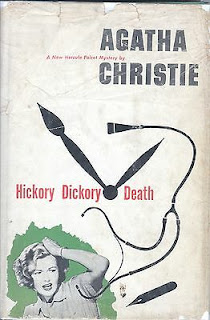
Hickory Dickory Death by Agatha Christie (1955)


Major characters:
  • Mrs. Hubbard, warden (manager) of the Hickory Street Hostel
  • Mrs. Nicoletis, owner of the hostel
  • Sally Finch
  • Elizabeth Johnson
  • Patricia Lane, archeology student
  • Nigel Chapman
  • Len Bateson, medical student
  • Valerie Hobhouse
  • Celia Austin, pharmacy dispenser
  • Colin McNabb, psychology student
  • Inspector Sharpe
  • Hercule Poirot
Locale: Greater London

Synopsis: Miss Lemon, secretary to Hercule Poirot, relates how her sister, Mrs. Hubbard, is having some troubles at the hostel she manages. It sounds curious so Poirot goes to see her.

The Hickory Street Hostel (hence the title), consists of two separate buildings (one for men, one for women), joined by a common dining/lounge area. The residents are mostly students, with a few general renters thrown in.

Mrs. Hubbard manages the day-to-day operations on behalf of the owner, a rather biploar Mrs. Nicoletis, a hard-drinking Greek who alternates between screaming rage and bubbling praise.

The hostel has been plagued with a rash of strange little thefts and small vandalisms. The items stolen have no intrinsic value - cosmetics, a shoe, light bulbs, bath salts, a compact, etc. A rucksack (backpack) and a scarf had been stolen and cut up. Only one valuable item - a diamond ring - was stolen, but quickly returned. Was it taken by mistake?

Poirot finds one of the roomers, pharmacy dispenser Celia Austin, is the culprit. It appears she had been trying to attract the attention of psychology grad student Colin McNabb by assuming symptoms of kleptomania*. She confesses to the roomers and that seems to be end of it, but that night she is found dead by poison; and Poirot is convinced it is murder.

the recurrent failure to resist impulses to steal items even though the items are not needed for personal use or for their monetary value. (APA, as quoted in linked WIkipedia article)

Review: It is not a significant crime, but rather some petty thefts which attract the attention of Hercule Poirot - and not through the police, but rather his secretary. The hostel is home to a variety of personalities and backgrounds, and the mix makes for a good story. 

The list of pilfered items is a puzzle, trying to find what they may have in common. The reader would be best to consider which two of these items are not like the others? The episodes of which poison is in which bottle is quite a shell game, and I didn't attempt to follow the moves there and just took her word for it.

I thought I had the culprit in mind from the start. Then, I abandoned that choice as too obvious. Silly me, fooled by Agatha again.


Looking for my mystery reading challenges? Visit The Mystillery

Thursday, October 21, 2021

The Moving Finger by Agatha Christie (1942)


dustjackets.com


Major characters:
  • Jerry Burton, our narrator, recovering from a flying accident
  • Joanna Burton, his sister
  • Miss Emily Barton, who rents her house to the Burtons
  • Dr. Owen Griffith, the local doctor
  • Aimee Griffith, Owen's energetic, masculine sister
  • Dick Symmington, a lawyer
  • Mona Symmington, his wife
  • Megan Hunter,  Mona Symmington's daughter by previous marriage
  • Elsie Holland, governess to two young Symmington children
  • Mr. Pye, a decoration and antiques enthusiast
  • Agnes Wooddell, maid
  • Caleb Dane Calthrop, the vicar
  • Superintendent Nash
  • Inspector Graves of Scotland Yard
  • Miss Jane Marple
Locale: Lymstock, a small village in rural England

Synopsis: Jerry Burton is recovering from injuries received in an airplane crash. His doctor suggests some rest in the country, so he and his sister Joanna Burton rent a cottage from Miss Emily Barton in Lymstock. 

Not long after their arrival, Jerry receives an anonymous letter - created by cutting words from a book, ransom-note style. The letter wrongly asserts that Jerry and Joanna not brother and sister, implying they are lovers - living in sin. As Jerry becomes acquainted with the locals, he learns that many of the them have received anonymous letters of the same sort, all accusing the recipients of some sexual infidelity. 

Jerry becomes friends with Megan Hunter, 20-year old daughter (by previous marriage) of Mona Symmington. Megan is a sensitive loner and anti-social, but is comfortable with Jerry. Mona receives an anonymous letter, and is found dead - supposedly a suicide - by poison. Then maid Agnes Wooddell is found murdered in the house as well.

Review: This is a very enjoyable Miss Marple, although she does not appear until the end. Even with the large number of characters, I had no trouble keeping track of them. It is a tight mystery story, with a couple romantic entanglements thrown in which resolved nicely. 

I enjoyed the character of the narrator, physically limited by his injuries, as he investigates the murders - and keeps running into Superintendent Nash who always just beats him to it. He did remind me of L. B. Jeffries in Cornell Woolrich's Rear Window.  

Megan is an enjoyable character, well-drawn, and a perfect companion for Jerry.

I thought I had the murderer 'fingered' and was hoping I was wrong. I was wrong. 

I suspect the title 'Moving Finger' is an allusion to the biblical account of the moving finger and the handwriting on the wall, as recorded in Daniel 5 (details); in which a disembodied hand wrote a mysterious message; similar to the unknown hand in this story which wrote the anonymous letters.


Thursday, August 19, 2021

Poirot Loses a Client by Agatha Christie (1937)


dustjackets.com

This is Hercule Poirot #20, also published as Dumb Witness.

Major characters:
  • Emily Arundell, who fell down the stairs
  • Charles Arundell, her nephew
  • Theresa Arundell, her niece, and sister to Charles
  • Dr. Rex Donaldson, fiancé of Theresa
  • Bella Tanios, another niece
  • Dr. Jacob Tanios, Bella's husband
  • Wilhelmina "Minnie" Lawson, companion to Emily
  • Ellen, housekeeper
  • Annie, cook
  • Dr. Grainger, Emily's physician
  • Hercule Poirot
  • Capt. Arthur Hastings, Poirot's companion and our narrator
Locale: Littlegreen House, Market Basing

Synopsis: Elderly Emily Arundell is the last of a generation living in the family home, and as such, has a substantial estate from her inheritances. Her nephew, Charles Arundell; and her nieces Theresa Arundell and Bella Tanios, are expecting to inherit from her. Charles can't wait and is always seeking 'loans' from Emily, but she holds tight onto the purse strings. Theresa can't wait to finance her husband - Dr. Rex Donaldson's - career. Bella can't wait to provide a better life for her husband - Dr. Jacob Tanios - and their two children.

Bob the dog has a favorite game. He sits at the top of the stairs while a person at the bottom tosses his ball to him. He catches it and pushes it off the top so it bounces back down. One night Emily approaches the stairs in the dark, trips, and falls down the length of the stairs. She is shaken but not injured seriously. Charles holds up the ball at the bottom of the stairs, and declares Emily must have stepped on it.

Emily is adamant she did not step on the ball. It had been put away in its drawer for the night. She suspects one of her relatives may be trying to hasten their inheritance, and on April 17 writes a letter to engage Hercule Poirot to investigate. Emily sets her letter aside. On April 21 her lawyer Purvis draws up a new will for her, cutting out her relations and leaving everything to housekeeper Ellen. On May 1 Emily passes away, believed to be natural cause. Eventually housekeeper Ellen comes across the sealed letter to Poirot, and drops it in the post. Hercule Poirot receives it on June 28. He and Capt. Arthur Hastings head out to Littlegreen House to see Emily, to find she is already dead and buried, with her house for sale. 

Poirot considers Emily his client, even though she is dead, and feels responsible to investigate. Posing as a potential buyer, Poirot inspects the house and finds evidence that a string or wire had been placed across the top of the stairs to precipitate Emily's fall.

Review: 

This novel follows the tried-and-true formula:
  1. Last of a generation holds all the wealth
  2. Grasping relations can't wait to inherit
  3. Annoyed, last of a generation makes new will, cutting out the relations 
  4. Murder!
  5. Shell game with the wills
There are references to "crossed writing" to which the reader may be unfamiliar. This was a common practice at the time to save paper and minimize postage cost, and consisted of writing a letter in the usual manner, turning the page 90 degrees, and continuing to write the "second" page crossways directly on top of the first. Then the page was turned over and pages 3 and 4 written on the back in the same manner, thus squeezing four pages of text onto one sheet of paper.

crossed writing

This was a great read and enjoyed how the evidence of the dog-and-ball was worked in. Charles was as interesting character, I could never quite figure him out. Is he a rogue or just a carefree ne'er-do-well?

The story is not quite linear - Emily's death is announced in the first sentence. Then the story is told in flashback after Poirot receives the delayed letter - an interesting method.

The character Ellen is never introduced, and just pops into the story unannounced. After a while I surmised she is Emily's housekeeper.

My copy is a ex-library 1937 first edition which is falling apart, but complete: 


I find it fascinating to look at the signout record on the inside back cover, and think about how people on the home front during WWII got through it with the help of Agatha Christie! Patron 318 was reading this very copy during the attack on Pearl Harbor (Dec. 7 1941)!


Also see this review by Bev Hankins on My Reader's Block.