Saturday, July 16, 2022

C is for Corpse by Sue Grafton, 1986


About the author: Sue Taylor Grafton (1940 – 2017) is best known as the author of the 25 "alphabet series" ("A" Is for Alibi, etc.) novels featuring private investigator Kinsey Millhone in the fictional city of Santa Teresa, California (based upon Santa Barbara). She was the daughter of detective novelist C. W. Grafton.

Major characters:

  • Bobby Callahan, twice the victim
  • Glen Callahan, his mother
  • Derek Wenner, his stepfather
  • Katherine "Kitty" Wenner, his stepsister
  • Rick Bergen, another victim, and Kitty's boyfriend
  • Sufi Daniels, friend of the Wenners
  • Dr. Leo Kleinert, a psychiatrist
  • Dr. James Franken, M.D. & his cougar wife Nola
  • Kinsey Millhone, private investigator and narrator
  • Henry Pitts, Kinsey's landlord
  • Lila Sams, Henry's new lady friend

Locale: Santa Teresa, California

Synopsis: Kinsey meets 23-year old Bobby Callahan at her gym. He is recovering from a host of  injuries, sustained in a car crash in which he was driving, and his friend Rick Bergen was killed. Upon learning Kinsey is a P.I., he hires her to investigate the accident. He had been forced off the road by someone, and Bobby claims it was attempted murder.

Kinsey meets Bobby's wealthy family: mother Glen Callahan, stepfather Derek Wenner, and stepsister Katherine "Kitty" Wenner  - who is heavily into drugs. Kinsey begins the preliminaries, but no sooner has she begun meeting with the family and doctors, than Bobby is killed in a second car accident, which turns out to be no accident at all.

Meanwhile, Kinsey's landlord, Henry Pitts, has a new lady friend Lila Sams; but she ain't no lady. She is a gold digger out to scam Henry of his savings. 

Review: I really enjoyed this third book in the series. There is a small cast, and the action moves right along. It adds to the enjoyment when Kinsey, as our narrator, constantly thinks-out-loud her comments about the various people. The scenes in the Callahan/Wenner household gave me a good idea of how the other half lives.

Sufi Daniels was a puzzle, she pops in and out but her connection to the story is quite slim and I never quite figured her out.

The sub-plot about Henry and Lila Sams also adds another dimension, even though you know how that is going to wind up.

The book builds to a climax which occurs in a hospital morgue, where Kinsey finds herself alone with the killer. If you enjoyed Robin Cook's Coma, you will enjoy this hospital chase too. 

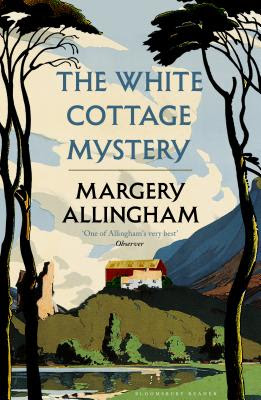
The White Cottage Mystery by Margery Allingham, 1927


About the author: Margery Louise Allingham (1904 – 1966) was an English novelist from the "Golden Age of Detective Fiction", best remembered for her hero, the gentleman sleuth Albert CampionInitially believed to be a parody of Dorothy L. Sayers's detective Lord Peter Wimsey, Campion formed the basis for 18 novels and many short stories. (from Wikipedia)

Major characters:
  • Chief Inspector W. T. Challoner
  • Jerry Challoner, his son
  • Roger William Christiansen, owner of The White Cottage
  • Eva Grace Christiansen, his wife
  • Joan Alice Christiansen, their daughter, age 5
  • Norah Phyliss Bayliss, Eva's sister
  • Eric Crowther, their neighbor at The Dene, and the victim
  • Clarry Gale, a.k.a. William Lacy, valet to Eric Crowther
  • Latte Cellini, resident of The Dene
Locale: England, Paris, and Mentone, France

Synopsis: Jerry Challoner encounters, and is enchanted by a young lady - Norah Phyliss Bayliss - whom he meets as she steps off a bus. He watches as she enters The White Cottage. The Cottage is also home to Roger and Eva Christiansen, and their five-year old daughter Joan Alice. 

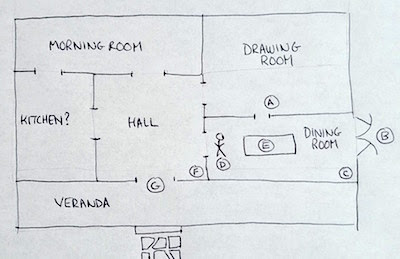
Almost immediately a shot is heard from the cottage, and a cry of murder. Jerry rushes in to find the house in turmoil and a body (D below) in the dining room. It is Eric Crowther, their neighbor, who lives next door at 'The Dene', an imposing institutional-like grey building. Jerry identifies himself as the son of Scotland Yard Chief Inspector W. T. Challoner. 

Crowther has been killed by a shotgun blast, the gun found resting on the dining room table (E). The Challoners soon find that Crowther was disliked by all, and took pleasure in tormenting others. There was a past affair between him and Eva, and he had taunted Roger (confined to a wheelchair) about it, daring him to shoot him - even conveniently providing the shotgun which he had left propped up in a corner (C) of the dining room. 

The Dene was also home to Latte Cellini, a mysterious Italian who suddenly disappears. Taking this as a sign of guilt, Challoners follow him first to Paris, then to Menton on the French Riviera. The Challoners are surprised to find Eva and Norah there as well.

Here is a possible layout of The White Cottage, reverse-engineered from the text showing the rooms of significance - omitting stairs, bath, etc. The Dene is off to the right. You may find this helpful as much conversation is about how the killer got in and out, and movements of the family during that time.


A - the narrow door
B - French windows
C - where Crowther propped the gun
D - body of Crowther
E - dining room table
F - coat rack
G - front door

Review: This is my first Allingham read, and it was quite enjoyable. Originally published as a serial, its heritage is apparent. Similar-length tight chapters are quite focused and well organized. It was edited prior to publishing as a book to remove the traditional lead-in synopses. The murder occurs immediately in chapter one, and all the characters introduced neatly in chapter two.

The story is stretched a bit by several coincidences, as the Challoners just happen to meet up with Eva and Norah in Paris, and then again in Menton. 

One story line which I expected but did not occur was some explanation of The Dene - being described several times as a grey, institutional building - I expected some creepy hanky-panky going on there but no.

Also see this review by Bev Hankins on My Reader's Block. 

Wednesday, June 15, 2022

The Tragedy at Brookbend Cottage by Ernest Bramah, 1914


About the author: Ernest Bramah (1868 - 1942) was an English author. He published 21 books and numerous short stories and features. Bramah created the characters Kai Lung and Max Carrados. (excerpt from wikipedia)

Major characters:

  • Max Carrados, blind amateur detective
  • Parkinson, his butler/guide
  • Louis Carlyle, private inquiry agent
  • Lt. Hollyer
  • Millicent Creake, sister of Lt. Hollyer
  • Austin Creake

Locale: London

Synopsis: Lt. Hollyer comes to amateur detective Max Carrados with a concern about his sister, Millicent Creake. Millicent, 28, is married to a much older man, Austin Creake. He is a taciturn man, and the marriage was discouraged by the family. 

Lt. Hollyer believes that Austin plans to do away with Millicent, by poison. His motive: under the terms of the will of Lt. Hollyer and Millicent's parents, she receives regular income from investments, and at her passing, the lump sum of principal would come to Austin. Austin keeps poison in a cabinet, in a beer bottle, along with bottles of actual beer. Lt. Hollyer thinks Austin will trick her into drinking the poison by mistake.

Carrados tells Hollyer to leave the area for a while. Then, he and private inquiry agent Louis Carlyle "case the joint" in hopes of trapping Austin. They pretend to be potential buyers of their house in order to get inside, where they find evidence of a strange electrical apparatus.

Review: You can pass this short story by. It is a strong story, building in action and tension until the trap is ready to be sprung, then the story comes to a sudden, crashing stop.  I turned the last page expecting the story to continue, but that was the end. The end feels rushed and unsatisfying on several levels.

The one part I did like is how Carrados manages to get a copy of a telegram sent to the Creakes. His method of obtaining it is a prime example what is termed social engineering* today. 

*the use of deception to manipulate individuals into divulging confidential or personal information.

You may also enjoy this review by Bev Hankins on My Reader's Block. 

Tuesday, June 14, 2022

The Mystery of the Vanished Petition Crown by Ernest Braham, 1927


About the author:
 Ernest Bramah (1868 - 1942) was an English author. He published 21 books and numerous short stories and features. Bramah created the characters Kai Lung and Max Carrados. (excerpt from wikipedia)

Major characters:

  • Max Carrados, blind amateur detective
  • Parkinson, his butler/guide
  • Greatorex, his reader
  • Louis Carlyle, private inquiry agent
  • Miss Frensham, a newspaper reporter
  • Muir, an auction attendent
  • Mr. Marrabel, an auction patron

Locale: London

Synopsis: Amateur detective Max Carrados is enjoying his newspaper as his reader, Greatorex, reads to him. The big story of the day is the disappearance of a valuable coin from an auction of Lord Willington's collection. The coin, called the "Petition Crown", is valuable because on a tiny engraved petition around the edge. 

Carrados' friend, private inquiry agent Louis Carlyle, calls him up and asks him to meet with a distraught newspaper reporer, Miss Frensham. She arrives and tells her story: she was covering the auction for her newspaper, and had asked the attendent Muir to let her examine the coin, Lot 64. He provided a tray holding a number of small numbered boxes. After she examined it, the attendent returned the tray to the cabinet until it came up for bid. When it was taken out again, Lot 64 was not the Petition Crown, but instead a common Crown coin. The auction was stopped, the premises searched, but the Petition Crown could not be found. Miss Frensham was the last to have handled it, and she had left the building for lunch shortly after - causing suspicion to fall upon her. 

While relating this story, she suddenly remembers that she had also picked up a common Crown from another box (lot 56) to compare the two, and surmises she must have inadvertently exchanged them when replacing them. However, the Petition Crown was not found in lot 56 either.

Review: This is a nice little shell-game story. It is obvious that if Miss Frensham didn't take it, some slight-of-hand has occurred. But the questions are: how was it done? who did it? and where is the coin now? Carrados visits the auction room and figures it out. It reminds me of an early Ellery Queen-like puzzle. The story is improved by Carrados having two simultaneous goals: finding the coin, and removing suspicion from Miss Frensham. 

You may also enjoy this review by Bev Hankins on My Reader's Block. 

Monday, June 13, 2022

The Mystery of the Poisoned Dish of Mushrooms by Ernest Bramah (1924)


About the author: Ernest Bramah (1868 - 1942) was an English author. He published 21 books and numerous short stories and features. Bramah created the characters Kai Lung and Max Carrados. (excerpt from wikipedia)

Major characters:

  • Max Carrados, blind amateur detective
  • Parkinson, his butler/guide
  • Louis Carlyle, private inquiry agent
  • Charlie Winpole, the sick child
  • Irene Dupreen, his aunt
  • Philip Loudham, Irene's brother
  • Robert Slark, M.D.

Locale: London

Synopsis: 12-year old Schoolboy Louis Carlyle, an orphan, lives with his aunt and guardian, Irene Dupreen. He becomes sick one day and she keeps him home from school, thinking he has the flu. She offers to prepare him a meal of his choice, and he asks for mushrooms. She purchases some from the local greengrocer, prepares and serves them. Later the boy is found dead.

Examination by physician Robert Slark shows death from bhurine poisoning, a component of poisonous mushrooms. The greengrocer is adamant he does not deal with any poisonous variety. Soon, Irene's brother, Philip Loudham, is arrested for the death. It is found that he and Irene will jointly inherit a substantial sum if they survive the boy, thus a motive.

Private Inquiry Agent Louis Carlyle had been retained by the prosecution. Meeting with his friend, amateur detective Max Carrados (who is blind), they discuss the case with Carrados taking a position for the defense of Loudham. 

The case rests on the source of the bhurine - was it from the mushrooms, or was it introduced separately? It has only one legitimate use, that in photography. Carrados finds it may be obtained from certain chemists, and finds a local chemist, Lightcraft, had supplied a quantity to a Mr. Paulden recently.

Review: Max Carrados and Louis Carlyle remind me of Inspector Richard Jury and his friend Melrose Plant, in the series by Martha Grimes. In both cases, the investigator has a society friend who does the legwork, and has the assistance of a worldly-wise servant (Ruthven for Jury, Parkinson for Carrados).

In this short story, the bulk of the action is an academic discussion between Carlyle and Carrados, as they discuss the case with Carlyle arguing from the prosecution's side (against Loudham), and Carrados arguing from the defense side. This is an interesting way to bring all the evidence in, since these two are usually allies.

A lot of work is done tracing mushrooms and bhurine. It is a bit unfair to the reader, as the person responsible for the death - lets just call it a third party - is only introduced at the very end; and all the mushroom and bhurine tracing turns out for naught. 

The physician Robert Slark is an enjoyable character. I hope he reappears in the other stories.

You may also enjoy this review by Bev Hankins on My Reader's Block. 


The Knight's Cross Signal Problem by Ernest Bramah (1914)


About the author: Ernest Bramah (1868 - 1942) was an English author. He published 21 books and numerous short stories and features. Bramah created the characters Kai Lung and Max Carrados. (excerpt from wikipedia)

Major characters:

  • Max Carrados, blind amateur detective
  • Parkinson, his butler/guide
  • Louis Carlyle, private inquiry agent
  • Hutchins, train driver
  • Herbert Mead, signalman
  • Mr. Drishna, a.k.a. Ghoosh, an Indian

Locale: London

Synopsis: Private Inquiry Agent Louis Carlyle has been retained by train driver Hutchins, following an accident in which his train ran past a signal and crashed into the rear of another, causing a number of deaths. Carlyle discusses the case with his friend Max Carrados, an amateur detective who is blind. 

The gist of the case is this: Hutchins claims he had a clear (green) signal. Signalman Herbert Mead swears he had put up a stop (red) signal. Both are adamant. Hutchins is despondent after being demoted to cleaning rest rooms, and has taken to drink. Carrados meets with him and believes he can clear him.

Carrados, guided by his manservant Parkinson, investigates the area of the signal in question, and finds it can be reached from the rear of an adjacent apartment; which had been rented by a mysterious Ghoosh.

Review: This is an excellent short story, and even fits in a couple of big surprises. The first is a tease about a relationship between Hutchins daughter Meg and the signalman, which Hutchins opposes. This is a clever piece of misdirection to the reader, suggesting hanky-panky by the signalman in a revenge move. Second, when a suspect is identified as having fooled with the signal, the question of motive remains. The motive is found, but it is not what one would expect. 

Alert: There is one instance of the n-word.

You may also enjoy this review by Bev Hankins on My Reader's Block. 

Wednesday, June 1, 2022

Dead Man's Float by Amber Dean (1945)

photo: FWM Docks*

About the author: Amber Dean (1902-1985) was born in Depew, New York, and married Norman J Getzin in 1926. Her papers are stored at the University of Rochester. Her series character was Albie Harris. Most of her books are set in upstate New York. The author's major fault lies in an overdose of melodrama, girls fainting, lying trussed in a bathtub filling slowly with water or having premonitions of danger which, of course, are never heeded. -- excerpt from Mary Ann Grochowski writing on gadetection.com.

Major characters:

  • Alberta "Abbie" Harris, our narrator, a widow
  • Lily Harris, her older sister
  • Maggie Harris, her younger sister, also a widow
  • Bill Hunt, their nephew
  • Bethine Coit, a temptress
  • Chester Coit, her husband
  • Max Johnson, a neighbor
  • "Mommie" Johnson, his wife
  • Mr. & Mrs Lane
  • Virginia Lane, their daughter

Locale: fictional Ogg Lake, upstate New York

Synopsis: Alberta "Abbie" Harris narrates this story, about her home in a small cottage colony on Ogg Lake during World War II. She lives there year-round with her sisters Lily and Maggie. Abbie and Maggie are both widowed, but have reverted to using their maiden names of Harris. Their nephew, Bill Hunt, is also there.

The other year-round residents are the Johnsons and the Lanes. The other cottages are occupied by summer rentals, the most notorious being Bethine Coit, next door. She parades around in her skimpy swimsuit and has various men visitors while her husband, a salesman, is out on the road.

The cottages are grouped in a semi-circle around a a small bay with a float containing a diving board in the middle, as I have sketched here: Keep this handy, it will save you a lot of critical thinking.


The trouble begins when Bethine Coit is found dead, under the float. The police investigate, but too slowly for neighbor Max Johnson. He snoops around on his own, then is injured in a boating accident which may not have been accidental. As Max recovers, her persuades Abbie to sneak into the Coit cottage and look for evidence. She reluctantly goes in but gets pushed down the stairs by a person unknown, and gets tangled up with Chester Coit who was just coming in. When the commotion gets sorted out, Chester is dead too. Abbie returns home and pretends no knowledge. In the morning, Chester's body is found (again), but this time it is on the float!

Review:

Living as I do on the Maine coast, I know how annoying the "summer people" can be, and the author makes her feelings about them quite plain. 

We have a large cast, and sometimes it is a bit hard to follow who is doing what. There are a lot of extraneous details, and it is a chore to try to remember what is germane and what is not. An editor could have deleted a lot of irrelevant details. Abbie has a definite self-image problem, and it gets a bit tiring hear her criticize herself for her 1). age, 2). weight, 3) appearance, and 4) marital status. 

In any event, Abbie is our reluctant detective, egged on by Max who can't do it himself due to his injury. The scenes of the locals crowding around the float and chipping off souvenirs makes it sound like the Harris' are on a level with the Kennedys.

The solution is a good twist, and a bit complex, but it does tie up everything nicely.

Please note Goodreads incorrectly combines this writer's works with that of a contemporary Canadian writer of the same name. This Amber Dean (Amber Dean Getzin) was born in 1902, according to her bibliography on Classiccrimefiction.com. Also see her file on gadetection.com.

If you enjoyed this book, you may also like The D.A.'s Daughter by Herman Petersen. Set in the same period, it also features a seductive blonde who gets drowned while having an affair, and it is also set in upstate New York! The author's name is Petersen, but it is sometimes misspelled as Peterson, so search for both. 

You may also enjoy this review by J F Norris on Pretty Sinister Books.

*Actual book cover photo was not available, so I made this one up with a catalog photo courtesy of FWM Docks.